

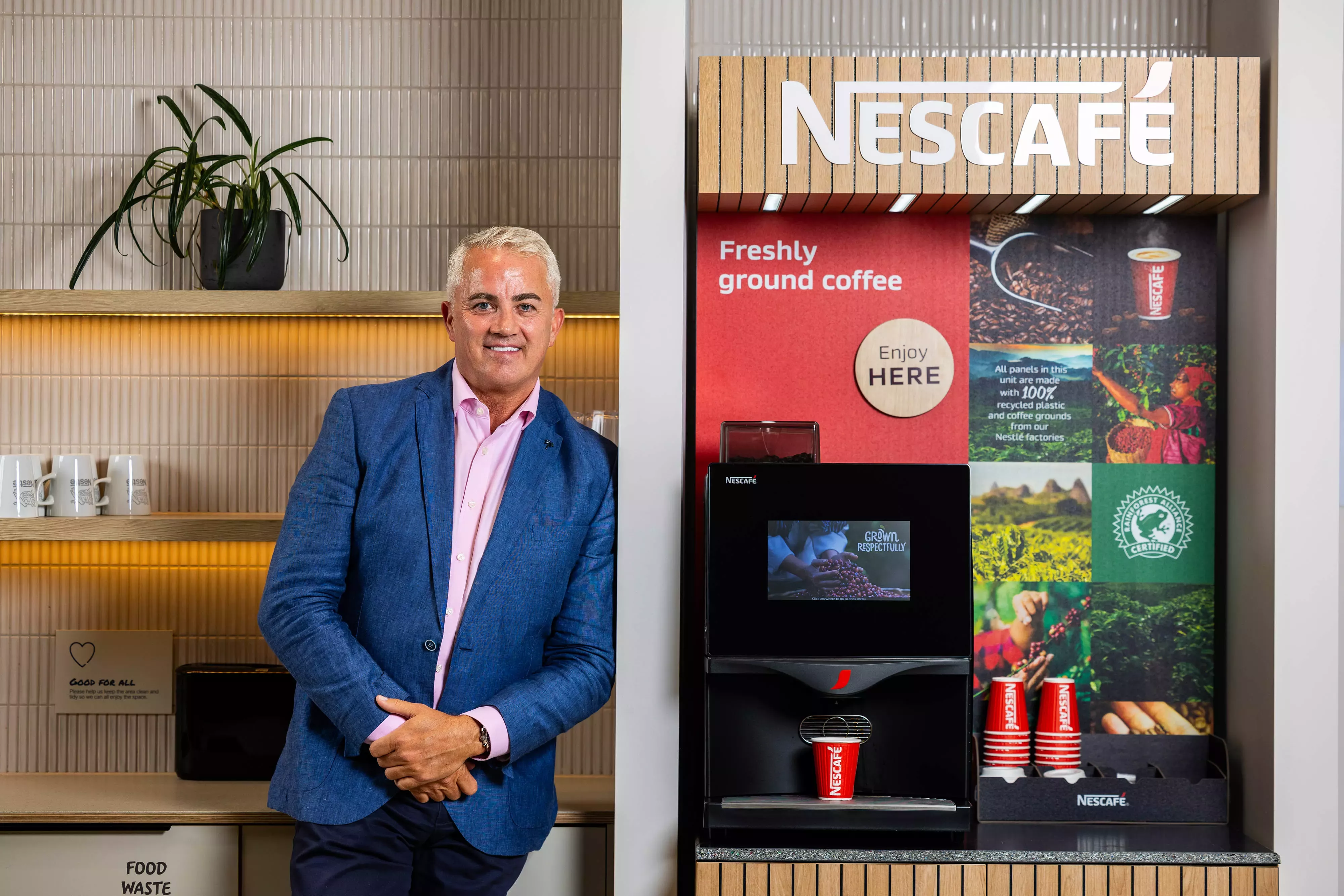
Nestlé Professional has transformed the way it builds its Nescafé self-serve furniture units – using a new material made from used coffee grounds and waste plastic sourced from our own operations. Developed with UK based manufacturer Regency, the new panels are made from 70% plastic waste from our Nestlé Tutbury factory and 30% used Nestlé coffee grounds.
This innovation supports our packaging and waste reduction commitments and delivers real impact with 70% fewer carbon emissions1 and a streamlined supply chain . Even small design details, like condiment holders, now embrace circular thinking – crafted from coffee grounds.
With more than 200 units already in use and interest growing across Nestlé global markets, the project has earned industry recognition, winning both the 2025 Footprint Award for Waste Innovation and the 2024 waste2zero Best Closed Loop Project Award.
It all started with one person asking a simple question: could we do this better?
Meet Stuart Fleming, Trade Asset Manager for Nestlé Professional UK and Ireland.
What’s your role at Nestlé?
“I look after coffee operations across multiple brands. That means making sure our machines are running smoothly, our engineers have what they need, and our consumers are getting a great cup of coffee – whether that’s in a supermarket, government building, or leisure centre. It’s a broad role, covering everything from the furniture that houses our machines to the payment systems that support them.”
What sparked this project?
“We’re always looking for ways to improve – what’s best for our market and how we can drive efficiency. One area that stood out to my team was the furniture housing our coffee machines, but more importantly the lifespan of the furniture. We realised some units were being thrown away after use on occasion. The old furniture was made from MDF, plastic and other virgin materials. That didn’t sit right with me. Surely there was a better way to do this.”
What happened next?
“I looked into UK manufacturers and connected with Regency; a company Nestlé has worked with for many years. I gave them the challenge, and they came back with a board made from ocean waste plastic and coffee grounds. I believed in the idea so much, I was eager to start building a business case.
“I asked Regency to build a prototype unit and put together a strong presentation. I pitched it to the senior team, and it landed. It was great. We started rolling out the new units to customers.”
How did you take it further?
“I wanted a truly circular solution using our own waste. So, I contacted our factories and was invited to our Tutbury factory, where we make Nescafé. I drove up and collected coffee and plastic waste and literally put it in the back of my car and took it to the manufacturer. They said ‘fantastic, it works’.
“The plastic comes from our Nescafé Dolce Gusto pods, leftover reels with holes in them from the production process. This plastic gets shredded, mixed with coffee waste, and heated to 200 degrees. Even the coffee waste helps fuel the manufacturing process. I spent two days with auditors at a recycling plant to get it accredited. Not too glamourous, but worth it. Now we’ve got a piece of furniture which is made entirely from our own waste.”
How does it feel to see the idea come to life?
“It’s been incredible. To the point where there’s been a joke about ‘Stuart’s furniture’, which is surreal. Customers are asking how they can recycle their own coffee and plastic waste. It’s opened up new conversations. I’m super proud of it.”
Any advice for someone with an idea surrounding sustainability?
“Don’t assume it’s someone else’s job. Ask yourself: how can I get involved? You might hit roadblocks, but if you believe in it, keep going. That one idea could make a real difference – to you, to the business, and to the environment.
“I cannot stress enough how important it is that we all view sustainability at the top of our agenda. We can all do something, personally and professionally, to support the environment. It’s worth a shot.”
1 Quantis for Regency conducted a 2018 Life Cycle Assessment which showed that in comparison to the previous Melamine Faced Chipboard (MFC) and MDF panels, these new panels generated 70% less carbon emissions, if used five times.
