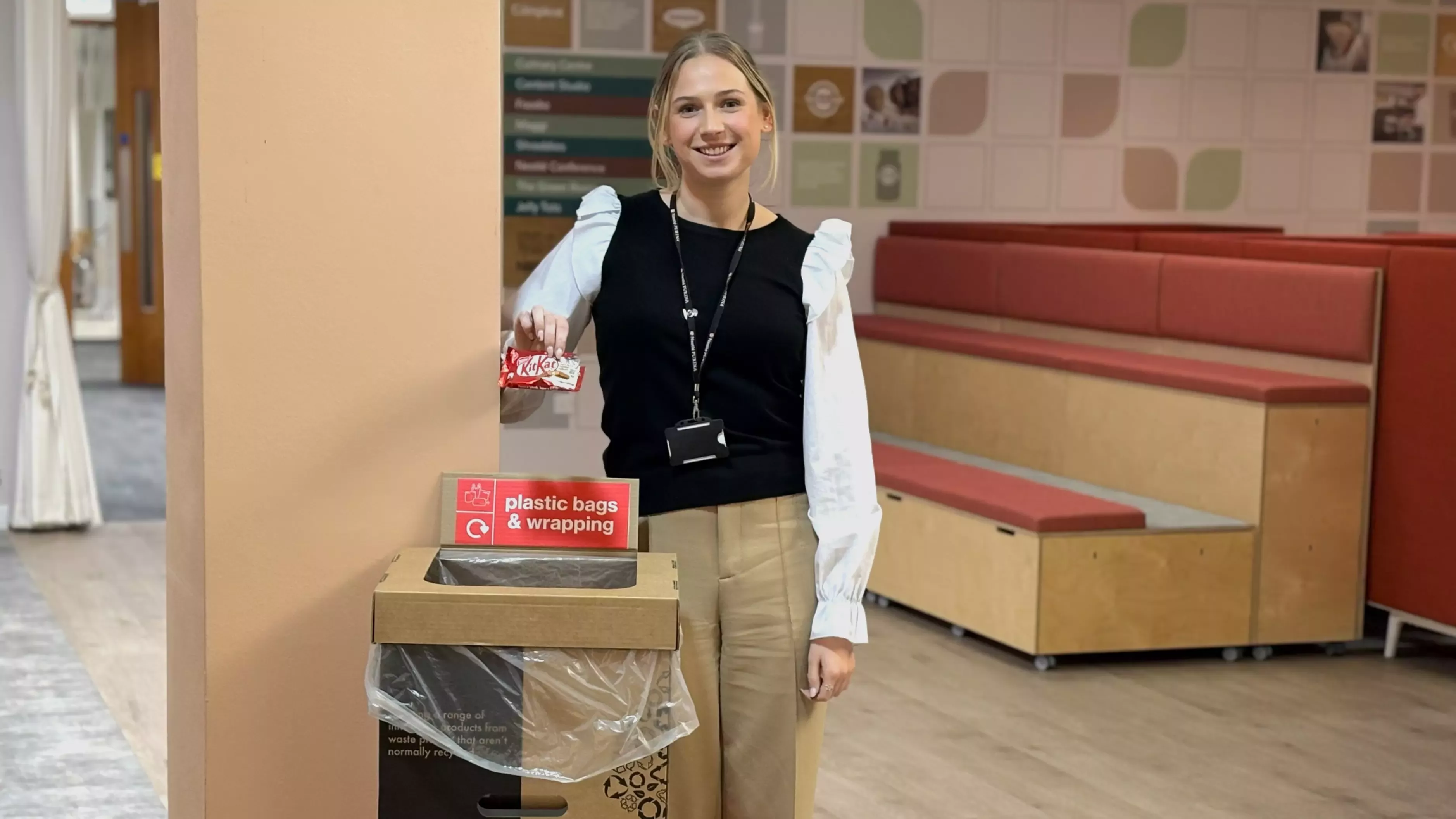
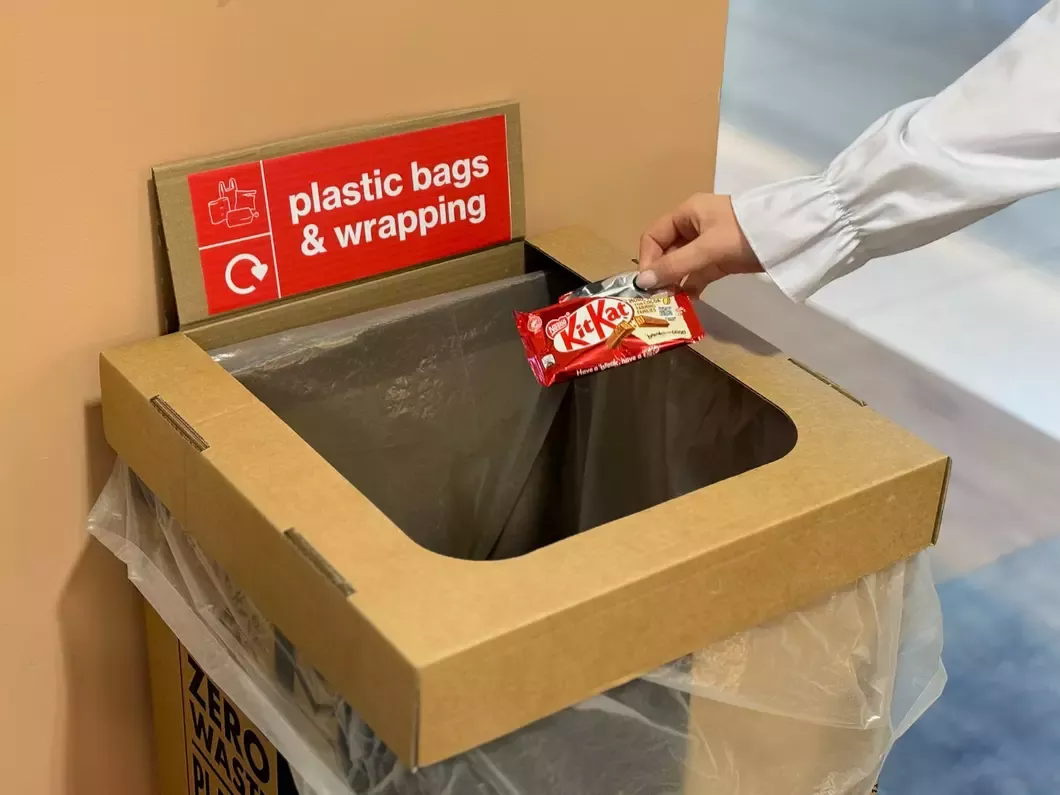
To make it happen, the graduate group teamed up with our food and facilities management partner, Sodexo, the Group Packaging and Facilities functions, and a colleague-run Regenerative Community Group, ensuring the bins were accessible and the waste properly processed.
Behind the idea, Q&A with the graduate team
We caught up with Michael Kehoe, Brand Manager, and Emma Marsden, Finance Analyst, to hear how the idea came to life.
Why flexible plastics?
Michael: I work in confectionery, and our bags and wrappers are designed to be recyclable at collection points like supermarkets. But sometimes it’s not always convenient to use these points. I saw this first-hand with a product I bought at our canteen. The best way to help people recycle is to make it easy. These bins do exactly that.
Emma: We started by understanding flexible plastics and how they’re used. Then we looked at how waste is currently handled on-site and explored external solutions that could work for us.
How did you kick this off?
Michael: We built a pitch deck and presented it to key stakeholders, including our CEO Richard Watson and Head of Sustainability, Emma Keller. Thankfully, we got the green light.
Emma: From there, we connected with Sodexo, Group Packaging and Facilities, and our Nestlé Regenerative Community Group, and held regular meetings to move things forward. Those teams helped aligned the project with Nestlé's sustainability goals. Sodexo handled the bin placement and waste logistics. Slowly the project became a reality. The trial is now live and will help shape how we scale it across the business.
What challenges did you face?
Michael: This wasn’t part of our day jobs, so we had to make time around our normal day-to-day and rally support from others around the business to do the same. That was a challenge in itself.
Emma: Three big hurdles of the project were contamination, keeping the bins clean, coordination, finding the right waste partners, and engagement, getting people to actually use them. We’re still working on that last one.
What did you learn?
Emma: Project management and stakeholder engagement, from planning to navigating cross-functional collaboration. But I also learned more about sustainability and communication, including how to craft messages that drive behaviour change.
Michael: Keeping communication flowing across the team was a key learning. There were many meetings and many email chains, keeping on top of them was important. It helped avoid duplicated work and kept things moving.
What does success look like?
Michael: Flexible plastic bins at every UK site, used properly, so no recyclable plastics end up in landfill.
Any advice for future Micro-Tyco participants?
Michael: Don’t try to fix everything. Pick one problem and be specific. Find people who can help you build the best solution. We couldn’t have done it alone. You can’t just place a bin somewhere and hope for the best – it has to be used properly and emptied correctly. We leaned on a lot of expertise, and it paid off.
Emma: Choose a project with real-world impact. Be resilient, make sure to celebrate small wins and use the experience to grow your skills and network.
More than just a bin
This project shows how young talent can drive real change, not just with ideas, but with action. From pitch decks to pilot bins, these graduates turned a small idea into something real, practical and scalable.