Gender Pay at Nestlé
Read our Gender Pay Report 2025 for Nestlé UK and Ireland

What is gender pay reporting?
The gender pay gap is a comparison of the average earnings for men and women regardless of the work they do. In both the UK and Ireland, there is a legal requirement for organisations to publish data on their gender pay gap.
The calculations for Ireland are slightly different to those required in the UK.
What is the difference between equal pay and the gender pay gap?
Gender pay reporting is the difference between the average earnings for all men and the average earnings for all women in an organisation*. It's not the same as equal pay which considers whether men and women are paid equally for equal work.
A gender pay gap can show that men or women are disproportionately in certain roles e.g., if men are disproportionately in senior roles there might be a gender pay gap in favour of men.
* You’ll see we look at a range of earnings figures.
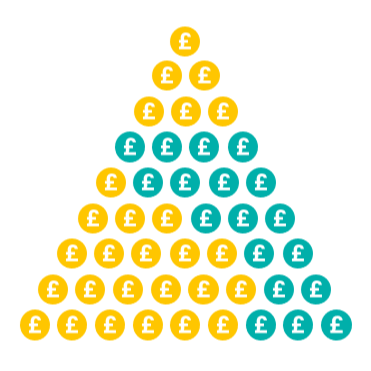

*This is not representative of our data but a visual example.
“Our approach to gender equity is simple. At Nestlé we believe in equal opportunities for everyone at every level. Not only is it our responsibility as an employer, but it’s essential for a successful business. We’re continually working to enhance our inclusive workplace culture, that allows all of our people to thrive and grow their careers in a supportive and diverse environment. There’s always more work to be done, but we’re proud of our progress so far.”

Why does it matter?
Gender pay reporting can highlight where there are differences in representation in organisations. For instance, if an organisation has more men than women in well-paid senior roles and more women than men in less well-paid junior roles, then the average pay for men will be higher than for women and there will be a gender pay gap in favour of men.
Our organisation is complex and so is our data. However, our approach is simple. We believe in equal opportunities for all genders at every level , which is why gender representation across our business is an important area of focus. Improving gender balance is an important part of our ongoing commitment to foster a culture where everyone thrives.
Our organisation
We have a variety of sites across the UK, including factories and warehouses, offices, Nespresso boutiques and a product technology centre. In Ireland, we have a head office and Nespresso boutiques.
Across our business, we have some high-level patterns in representation. In the UK and in Ireland, we have a slightly higher proportion of women than men in our offices and boutiques, around 60%. Across our factory sites in the UK we have a high proportion of men, more than 80%. At our most senior level, men still make up 60% of the represented group in the UK and so we know that we need to continue to focus on these areas although change takes time here and in the factory sites.
2025 data
When we refer to Nestlé in the UK, this includes a range of legal entities in the UK: Nestlé UK Ltd (which includes our Nescafé, Nestlé Confectionery, Nestlé Food, Nestlé Nutrition & Dairy, Nestlé Health Science and Nestlé Professional businesses, as well as factories and corporate functions such as Group HR), Nestlé Purina manufacturing and commercial operations, Nespresso, Cereal Partners, Nestlé Waters and Nestec York Ltd, which houses our Research and Development centre and for the first year in 2025 a new entity, Nestlé Global Services UK Ltd.
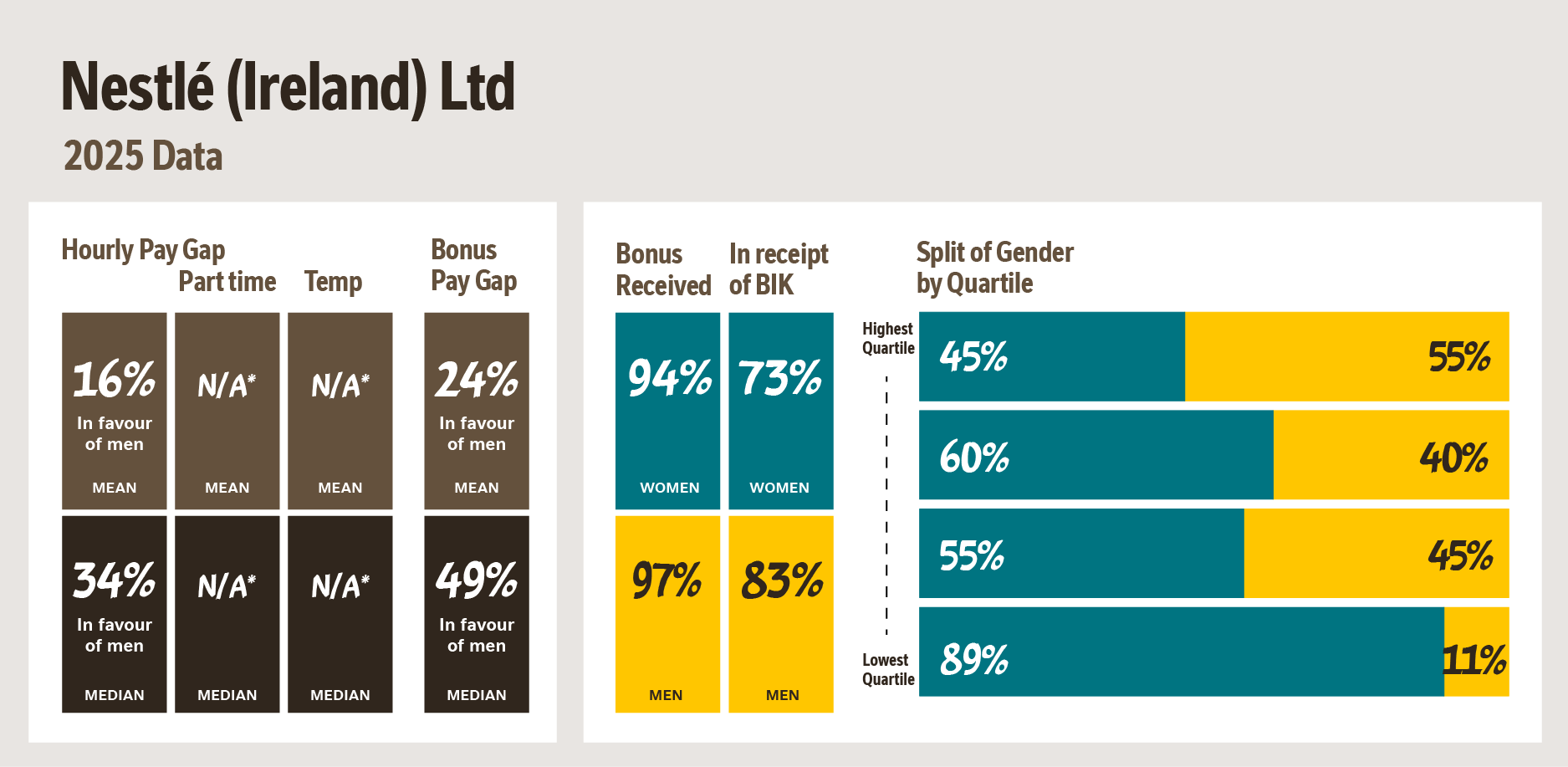
All these businesses share a common approach to pay and bonuses although there are some different schemes in place reflecting where individuals work. The 2025 report covers 7,035 people in the UK across a range of offices, factories, coffee boutiques and our product technology centre; and 79 people in Ireland.
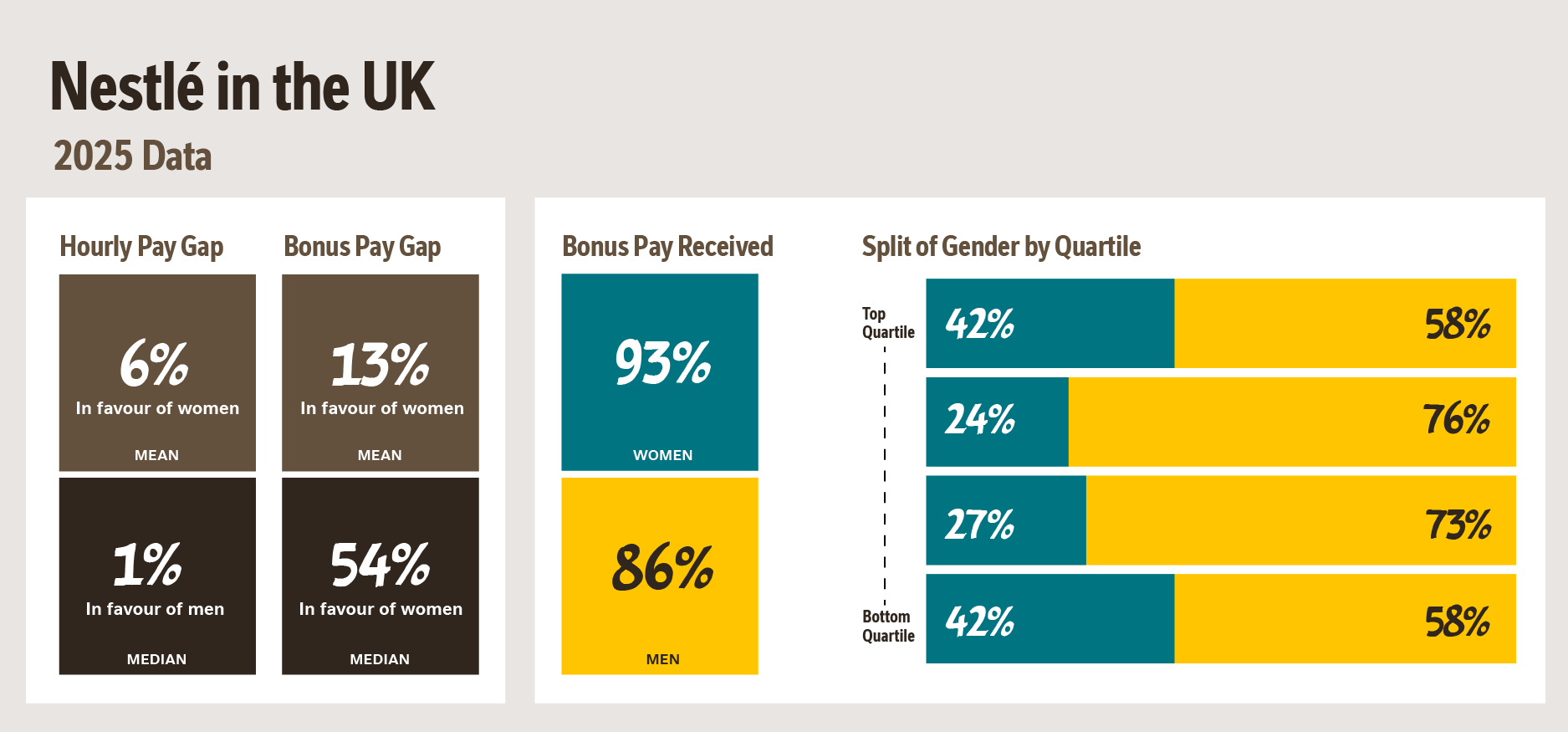
* We are not able to provide figures for this gender pay comparison.
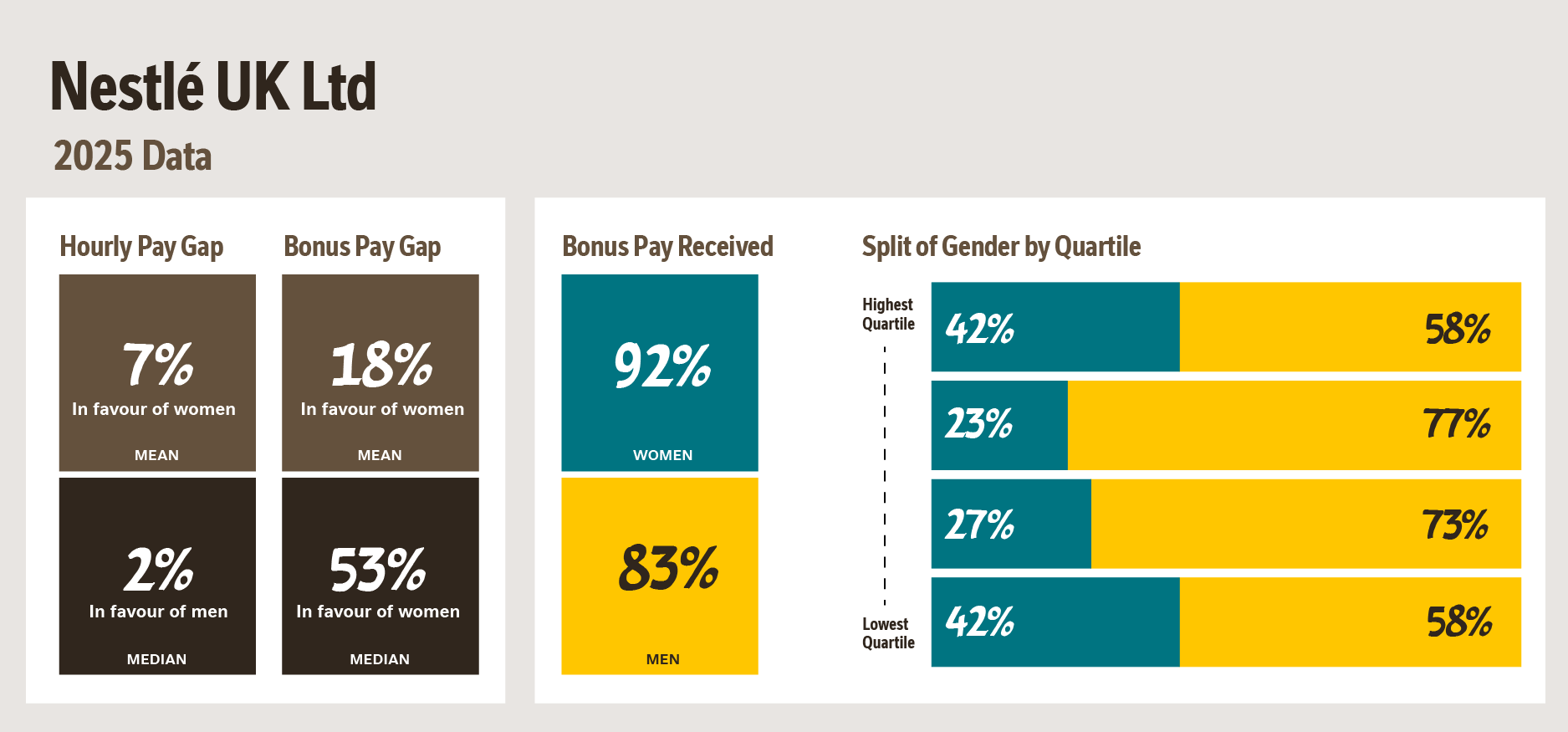
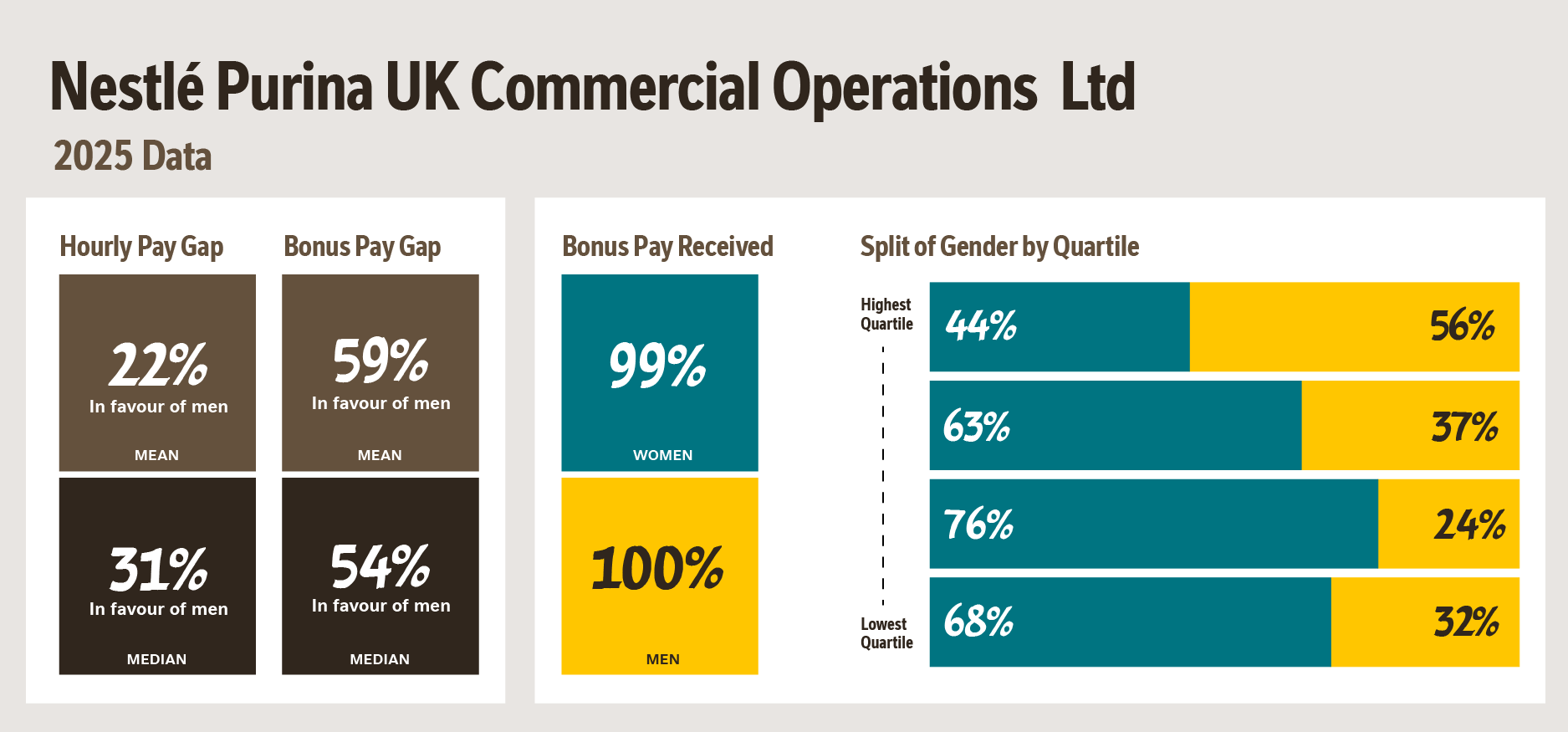
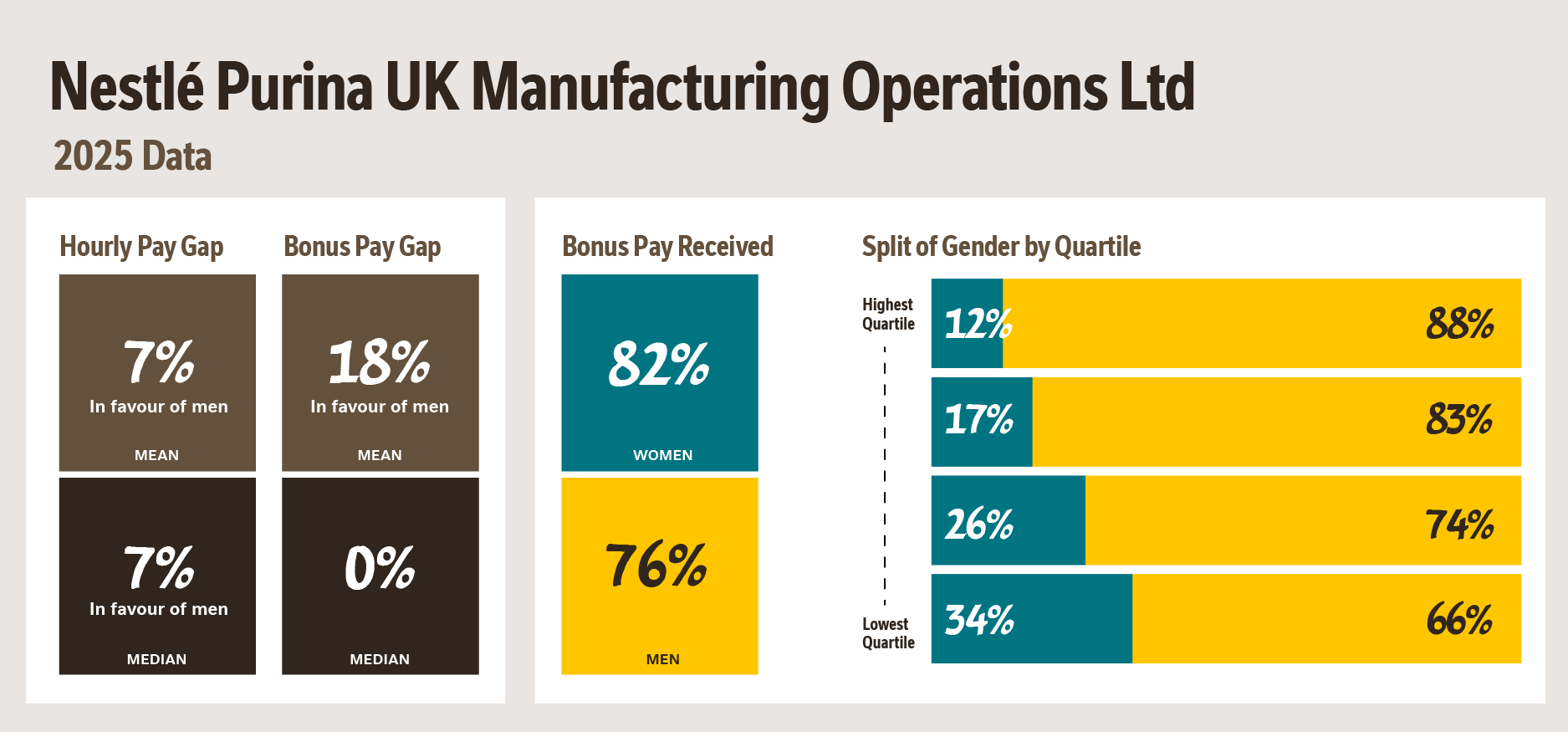
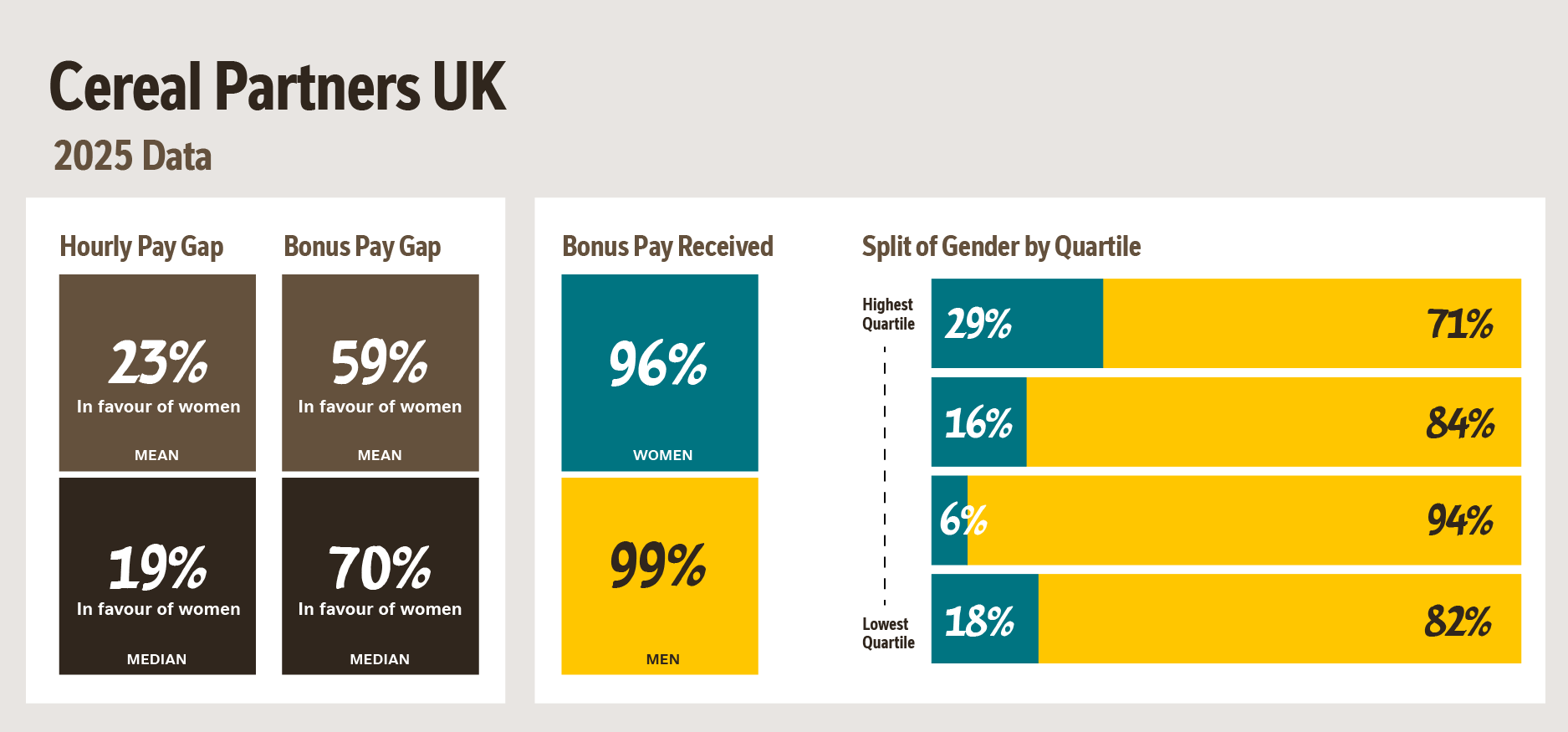
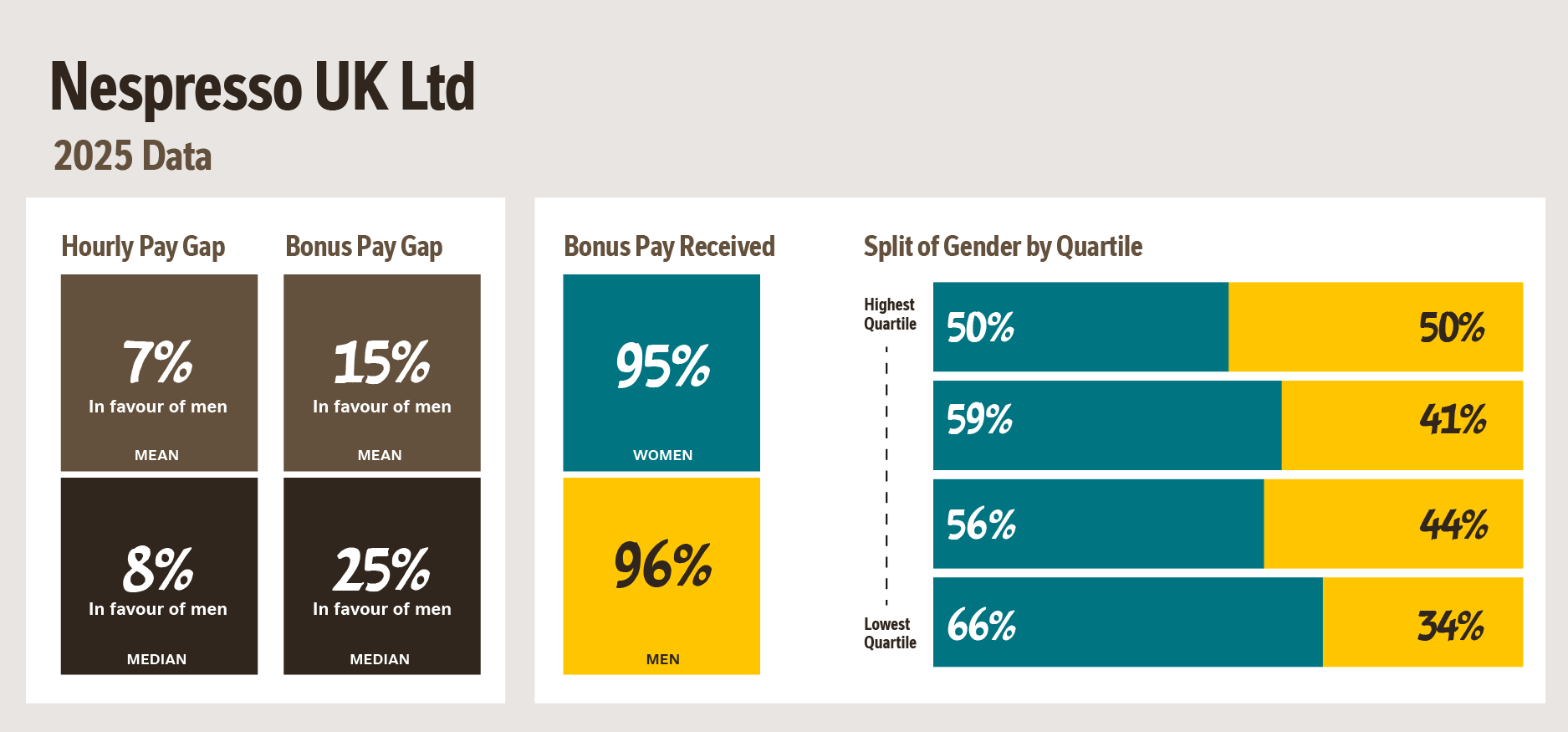
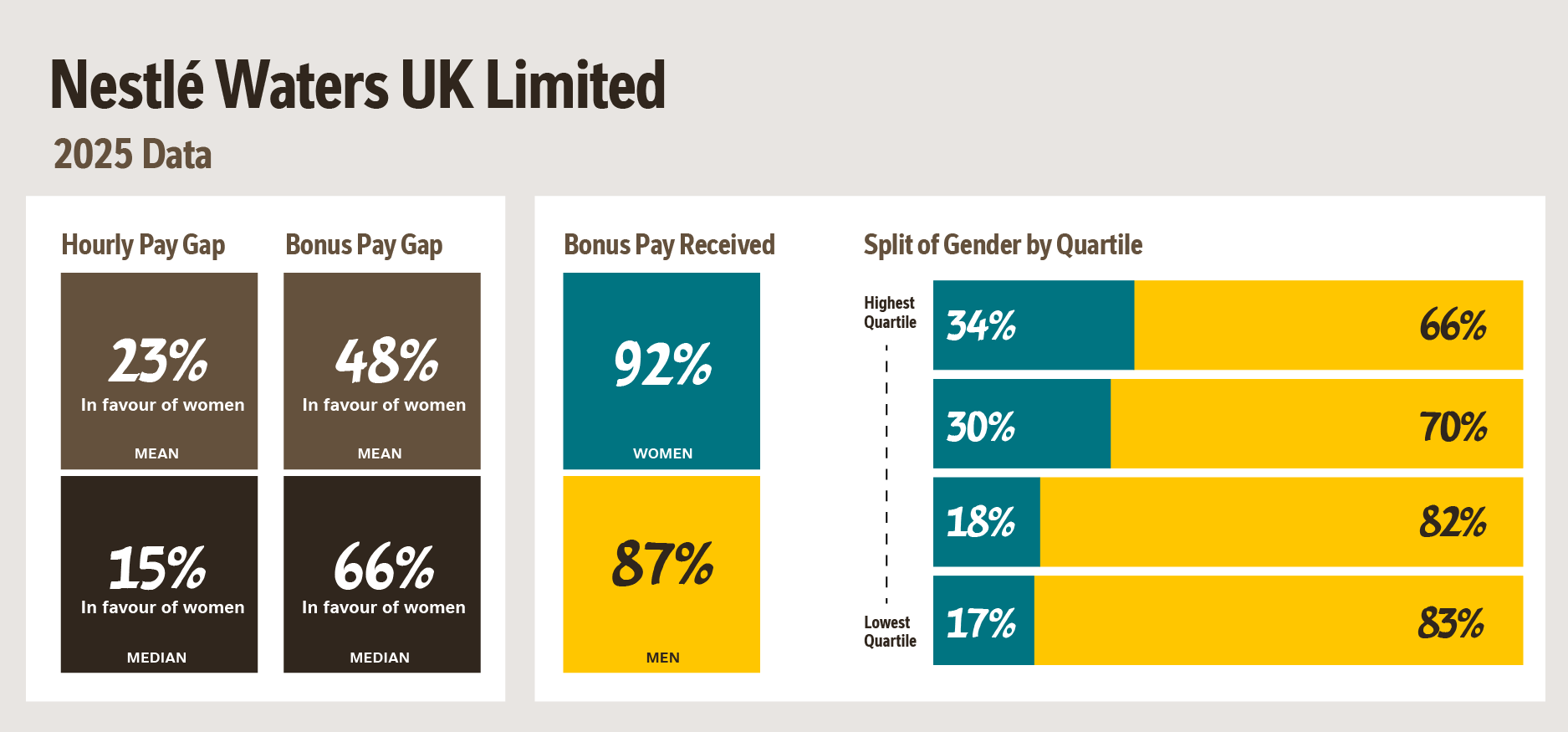
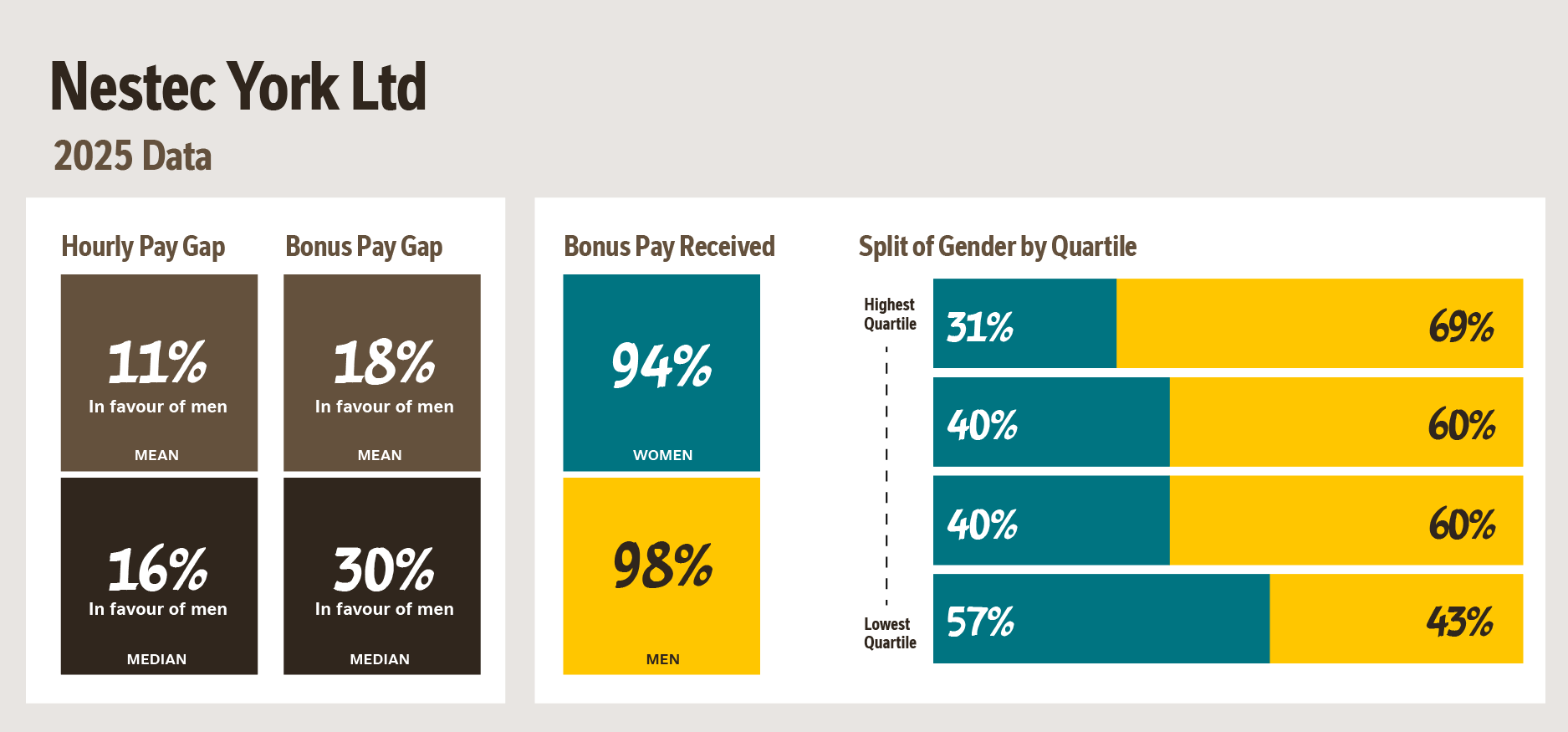
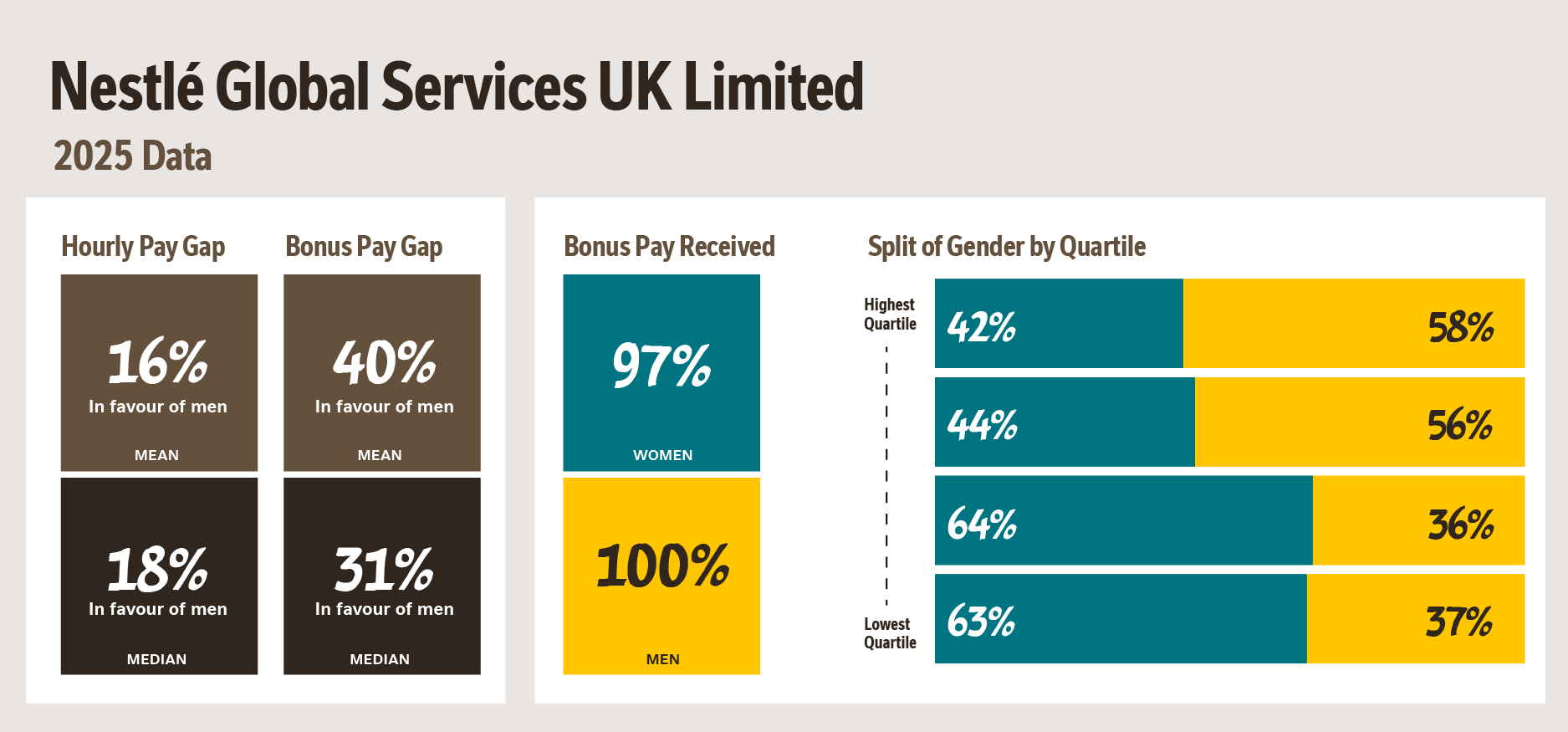

* We are not able to provide figures for this gender pay comparison.
Data
We have to report on mean and median data. Mean data is calculated by adding up all the numbers in a sample and dividing by the number in that sample.
Median data is calculated by arranging the numbers in order from the lowest paid to the highest paid, and the middle number is the median.
In our report, the calculations of mean and median gender pay gap and bonus pay gap are calculated by taking the figure for women away from the figure for men and dividing by the figure for men.
To calculate pay quartiles or quarters we put the pay of all individuals in descending order and then split them into four equally sized groups. We then report on the percentage of men and women in each group.
“I joined the UK and Ireland team in 2024 and it’s clear to me that the team is focused on improving our gender equality. As leaders, it’s vital that we foster an environment committed to improving representation at all levels across our business. Being able to bring your best self to work is a key part of our culture and it’s this value that truly helps our people develop and thrive here.”
About our data
While the data for each legal entity may look different, the challenges which sit behind this data are the same. We still have higher proportions of men in our manufacturing and supply sites as well as in our most senior roles and this imbalance drives our figures.
This is amplified in our bonus data as the bonus data relates to an annual figure.
We’ve been working to change this for some time but we recognise that it takes time to see the results. This is why our key areas of focus remain to increase representation across manufacturing and supply; increase representation in our most senior roles and ensure every facet of our employee experience fosters an inclusive culture.
We’ve outlined below the actions we continue to take. We continue to monitor progress and actions, making adjustments and improvements.
"We are making progress towards achieving gender equality at Nestlé UK and Ireland, however we are still not where we would like to be. We know our areas of focus where improvements need to be made and we’ll be continuing our work in these areas, looking to increase representation in our most senior roles and strengthening our pipeline for ready now successors."

Our Approach
We recognise that, although progress has been made, achieving gender balance within our organisation remains an ongoing journey. Our dedication to building a truly diverse and inclusive workplace is unwavering, and we are committed to providing equal opportunities for people of all genders to develop and advance their careers.
We hold our leaders accountable for championing inclusion and equity, setting clear goals for gender balance throughout the organisation. Our senior leaders are expected to drive progress, and we regularly review our strategies to make sure we remain on course to achieve balanced representation and foster an environment where everyone can thrive.
Attracting and developing talented individuals of all genders is a priority for us. Following a proactive recruitment audit, we have introduced changes to our recruitment practices which have already led to tangible improvements in gender balance. Our Nestlé Academy team has also been successful in attracting increasingly diverse cohorts of young people, helping to build a robust and representative pipeline of future leaders.
We understand that gender equality is a multifaceted issue, closely linked with other aspects of personal identity such as race, sexuality, disability, age, and life stage etc. Our approach recognises the importance of intersectionality, and we strive to support all colleagues in their unique experiences.
Hence our Diversity, Inclusion and Belonging strategy is designed to reflect the true diversity of society and ensure that difference is valued. To achieve this, we implement a range of initiatives, including Inclusion training for all our manufacturing colleagues, support from six colleague networks for marginalised communities and active involvement in external groups such as the Nestlé First Milk Women in Agriculture Group, the Women in Engineering Society, Andy’s Man’s Club, Stonewall Housing, and Carers UK. These partnerships and networks empower individuals of all genders facing challenges, with the shared goal of fostering a more gender-equitable society. We are also strengthening our supplier diversity programme, ensuring women-owned businesses have fair opportunities through our procurement processes.
We remain mindful that true progress is achieved through ongoing learning, allyship, and reflection. We are proud of the strides we have made, yet we understand there is still more to do. With humility and determination, we reaffirm our commitment to fostering an inclusive environment where everyone thrives, and no one is left behind.
Declaration of accuracy: I confirm that this statement is true to the best of my knowledge and belief."